


Newsrooms are not OK.
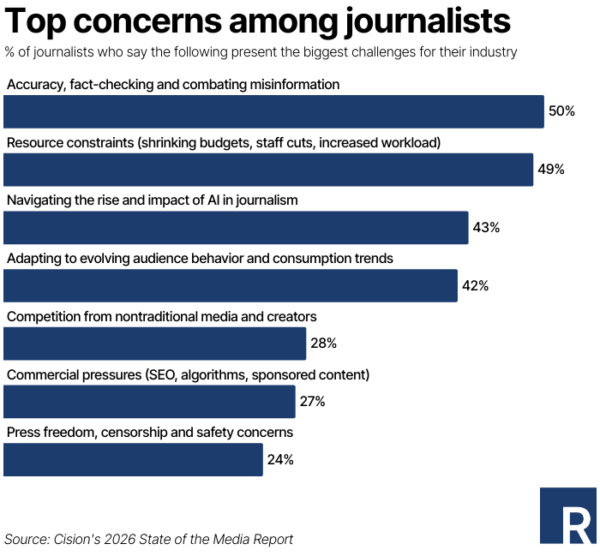
Data from Cision’s 2026 State of the Media Report, based on interviews with more than 1,800 reporters around the globe, shows 50% of journalists say striving for accuracy and combating misinformation has been one of their biggest challenges over the past 12 months.
In last year’s report, for comparison, 40% of journalists indicated maintaining credibility as a trusted news source and pushing back against accusations of “fake news” was a chief concern. At the same time, 20% listed verifying information and finding credible sources as a top challenge.
Another growing pain point for journalists: declining resources. Overall, 49% of reporters consider shrinking budgets, staff cuts and increased workloads a major challenge, up from 29% who said the same in Cision’s 2025 State of the Media Report.
Anxiety over the rise of AI has also increased, with 43% of journalists ranking it among their biggest challenges in 2026 compared to 30% who noted a similar feeling of uneasiness about the technology last year.
The good news for PR professionals is that they have what journalists need.
A world of opportunity
Overall, 66% of journalists rely on PR-provided content — pitches, media kits, press releases — to come up with story ideas. This makes PR their top source for inspiring their next article, ahead of social media, rival publications and industry events.
Most journalists say the best way for PR pros to begin building a relationship with them is through a simple email. All it takes is a quick introduction and reason for reaching out.
Following that, 97% of reporters prefer to stay in touch via email over other communication channels, such as texting, phone calls or various messaging apps.
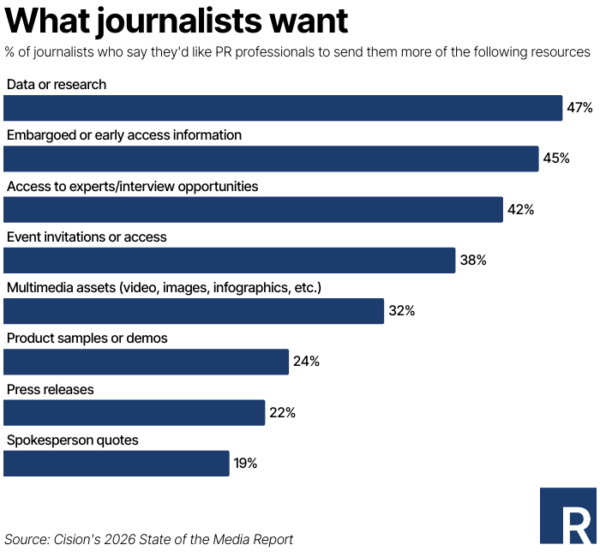
With the relationship in place, what journalists want from PR pros is data, embargoed stories and access to experts. In other words, credible content that informs their readers and rebuffs any charges of being “fake news.”
Invitations to events and multimedia assets are also in demand.
Always aim for relevance
On the flip side, the biggest mistake PR pros make involves sending story ideas to the wrong reporter. Most journalists say 25% or fewer of the pitches they receive are relevant to their beat.
Sure enough, the principal reason journalists give for blocking PR pros is an overflow of ill-suited pitches.
Amy Jones, Cision’s chief marketing officer, noted that while PR teams, like newsrooms, are under pressure to do more with less, it’s unwise to adopt a spray-and-pray strategy.
“In reality, that approach can backfire,” said Jones. “It erodes credibility and burns bridges.”
As for ensuring every pitch is relevant to the reporter receiving it, Jones advised PR pros to invest their time and energy into creating a curated list of journalists whose beats, audiences and previous work align with the story they’re pitching.
“At a time when journalists are inundated with media pitches,” said Jones, “thoughtfully tailored, human-to-human outreach is the competitive differentiator for PR teams.”
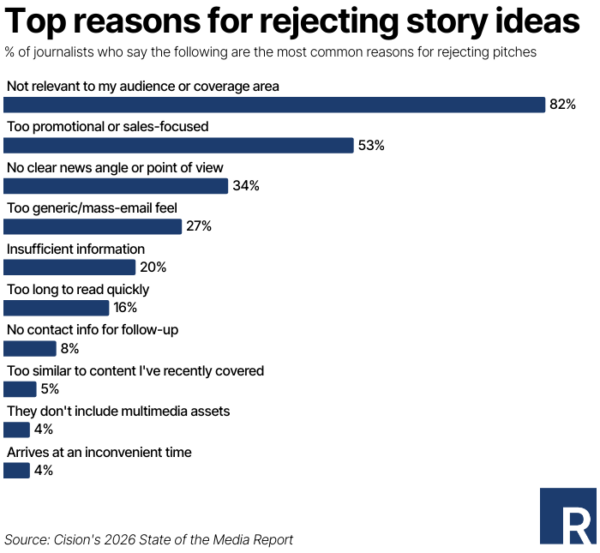
Overall, 82% of journalists say misalignment with their audience or coverage area plays a major role in their decision to reject a pitch.
Reporters are also likely to pass on story ideas that are too promotional in nature or lack a sharp angle.
Ongoing caution around AI
PR pros face another hurdle: Over half of reporters (53%) either strongly or somewhat object to receiving AI-generated pitches and press releases.
“This isn’t an overwhelming ‘no,’” reads a line from Cision’s report, “but it is an indicator that PR pros need to tread carefully with use of AI in content sent to journalists — accuracy, personalization and a human tone are critical.”
The results suggest attitudes toward AI-assisted PR material are softening as the technology continues to grow in prominence. Last year, 56% of journalists signaled opposition to receiving AI-generated pitches.
Nevertheless, the report advises PR pros to focus on what AI can’t replace: “Exclusive access, nuanced insight and authentic storytelling.”