
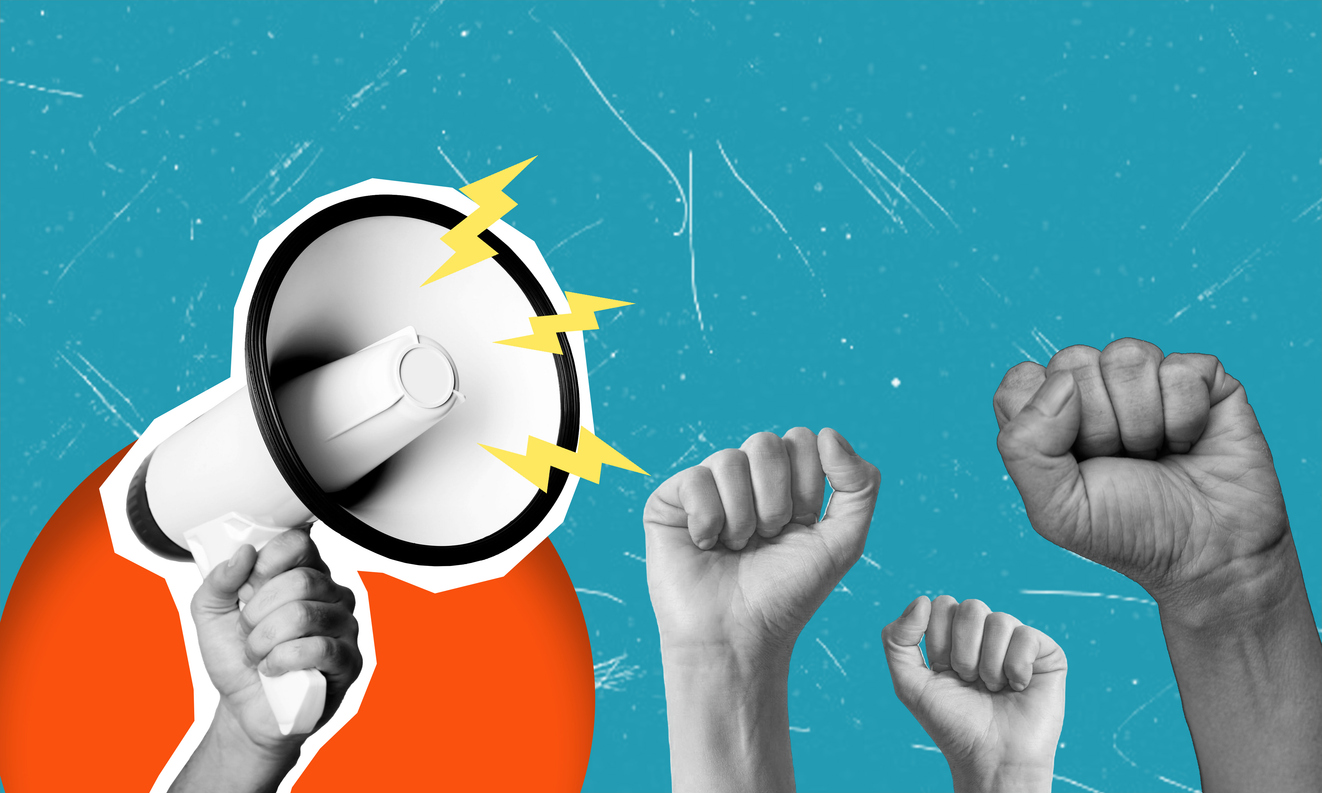


Modern art collage banner art featuring a crowd fists up and a megaphone on a blue background. This concept could be a protest, advertisement, or news piece.
Dustin Siggins is founder of Proven Media Solutions.
The Iran war was a stark reminder to members of my team that the entire communications industry can’t exist in Iran — because speech there isn’t free. If our clients and employers cannot speak freely, we will all lose our jobs, and possibly our lives.
But I wanted to uncover what the wider PR community thinks, and whether they agree with Think Big managing director Aaron Walker, who told me for this piece that nobody is “managing narratives” in countries like Iran. “They’re managing their survival.”
Here’s what some of them told me.
No free speech, no PR
One thread connecting everyone I talked to may seem obvious: free speech is the essential foundation for PR, and for the communications industry in general. But two things stood out: that PR practitioners see ourselves as obligated to stand for the free speech of others, and that the USA has had a lot of influence even in countries without the robust constitutional protections we enjoy.
Keith Pillow, founder, Caddy Marketing and Communications
As PR practitioners, I believe we have a moral and ethical obligation to preserve free speech and a free press so we can continue hearing…and learning…from a diverse range of people, groups and organizations. Finally, we must persistent in advocating for the protection of these liberties, and speaking up and out on behalf of those without voices.
Andrew Moyer, executive vice president, Reputation Partners
Being able to openly communicate what you or your organization stands for is more than just a privilege, it’s a vital tool for building trust and cultivating a strong reputation. That transparency is the cornerstone of creating lasting relationships, those “sticky” connections that drive brand loyalty and affinity and provide a crucial reservoir of goodwill when navigating challenging times. While we may overlook this freedom in our daily routines, it’s imperative that we recognize its value and remain vigilant in defending our right to express both support and dissent. Without this liberty, the very essence of our profession would be fundamentally undermined.
Not all roses and rainbows in the West
When I first arrived in France, I attended civics classes where liberté de parole — free speech — was emphasized as a core national value. As a communications professional, I believe that principle is essential to intellectual life, business and a healthy democracy.
That’s what Ellie Krasne, founder of Krasne Strategies and an American living in France, told me for this piece. Her statement articulated the understanding of free speech that every American is proud to share.
Jake Ciccarelli, senior account executive, FINN Partners
Disputes like the one between the White House and The Associated Press over editorial language and access remind us that pressure on the press can come from attempts to shape or punish coverage. That’s why defending a free press is a professional responsibility for communicators.
Alex Malouf, founder, Narrative Shapers
In much of the world there are limits to what you can and cannot say. This applies both to individuals and to organisations. And this is reflected in the PR industry. For example, I live in the Middle East, and PR here aligns itself with the message emanating from the government. If you have disagreements, you air such thoughts behind closed doors and not in public. This has been the case for decades, with ups and downs on where the limit is. To use a simile from my region, the lines of how much can be expressed are drawn in the sand.
One more point: many countries follow what is happening in countries such as the USA. And we notice what has been and is happening to your journalism industry. On a global level, I am increasingly seeing phrases such as “fake media” being thrown around when people in power don’t see what they want to see in the press. I would urge every communicator to stand up for their colleagues in the media, especially when they are targeted by those with power. We cannot do our job without them.
…Or the East
Cameron Craig is CEO of A Signature Story, and has led PR across Asia-Pacific for global brands including Apple, Amazon, Visa and PayPal. He said the public relations industry often adapts to the countries in which it is practiced.
Having worked in global communications roles, I’ve seen how the profession adapts to the political environment around it. In open societies, PR is often about helping organizations navigate scrutiny, criticism, and public debate. In places where speech is more tightly controlled — whether in parts of Asia or the Middle East — communications still exists, but the focus shifts toward corporate messaging, stakeholder management, internal communications and spokesperson training within clearly defined boundaries.
Don’t sell it short
We live in a volatile world, and an increasingly interconnected one. When news like war in Iran breaks, we notice what life is like over there, but others have come a lot closer to living it themselves. For example, Amanda Coffee, CEO of Coffee Communications, has run global comms teams in China, where speech regulations are closer to Iran’s than to America’s. She said:
Communications professionals help organizations build reputation capital by ensuring information is clear, accurate, and trusted. When companies can communicate openly, they reduce misinterpretation and misinformation that can damage relationships with stakeholders. Free expression makes that possible.
Prolexity co-founder and managing partner Doyle Albee put an even finer point on it. “In America, a CEO who stays quiet isn’t afraid of prison. He’s afraid of a bad quarter. That distinction matters — a lot.”
He continued:
Executives’ anxiety stems from lost contracts and shareholder calls, not from jail cells and threats against their families. And none of it functions without a free press. The Fourth Estate isn’t a nice-to-have — it’s the whole architecture of a functioning democracy. When the worst consequence of speaking your mind is a dip in your stock price, that’s not a limitation on free speech. That’s a remarkable luxury. Let’s never confuse the two.