





Managers are struggling to manage themselves.
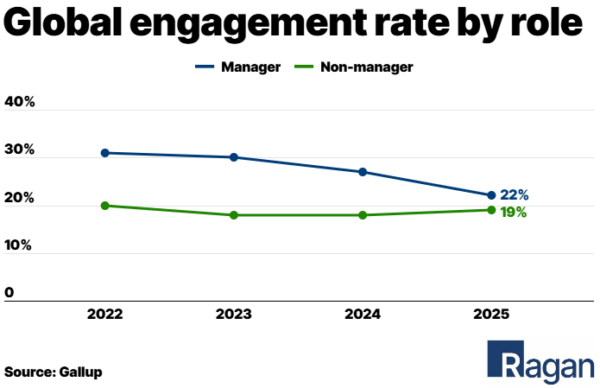
New data from Gallup shows just 22% of managers around the globe were engaged at work last year. That’s down nine points since 2022, when 31% of managers showed a healthy commitment to their job.
Given their leadership position, indifferent managers are bad for business. Their lack of care tends to spread.
“If managers aren’t engaged, they’re not going to be very inspired to engage the people around them,” said Jim Harter, Gallup’s chief scientist of workplace management and wellbeing. “The only way to build a consistent culture in an organization is to have managers who are highly enthused about building what the organization is trying to build.”
Although lower, engagement rates among non-managers have remained steady in recent years.
Why engagement is declining among managers
One reason for the decrease in engagement: an increase in responsibility.
Throughout the past decade, the size of teams at U.S. companies has grown. The average number of people reporting to a manager climbed from 8.2 in 2013 to 12.1 in 2025, according to additional figures from Gallup. This means managers have more personalities to manage, sometimes from a great distance.
Added up, the expectations take a toll. Managers are more likely than individual contributors to experience daily stress, anger and loneliness.
“Manager engagement isn’t shrinking because managers care less – I think the opposite is true,” said Lauren Butler, managing director of employee communications and engagement at Ketchum. “It’s shrinking because the role has expanded faster than the support around it.”
How internal communicators can help fix the issue
It doesn’t have to be this way.
At top-performing organizations that follow best practices, as defined by Gallup, 79% of managers report feeling engaged at work – a 57-point difference compared to the global average.
The first step to improving manager engagement is for the leadership team to better communicate where the company is going and why. Left in the dark, managers will grow frustrated because they can’t answer questions and address concerns coming from their team members.
“If you want managers to be your most trusted communicators, you need to treat them as your most intentional audience,” said Butler.
Leadership shouldn’t assume managers understand the reasoning behind high-level decisions. If they can’t articulate what matters most right now, why it matters, and what success looks like for their team, internal communicators need to focus on this lack of understanding.
“Managers,” Butler explained, “must be treated as a distinct audience with their own needs rather than a distribution channel.”
The next step is teaching managers how to be better communicators.
Many people step into managerial positions because they either were productive workers or have a long tenure at the company. Possessing one or two of these qualities, however, doesn’t make someone a natural communicator. Often, new managers have little to no experience managing other people.
“Managers are the most trusted communications channel – and the least trained to be communicators,” said Butler. “Providing managers with resources and training to communicate consistently with clarity, empathy and confidence is foundational.”
This can include toolkits, webinars and quick reference guides.
Finally, managers will benefit from having the ear of the executive team. This could mean regular meetings with members of the C-suite to align priorities and invite dialogue. Anything that breaks down unnecessary barriers will give them a stronger sense of agency.
As Gallup’s Harter put it: “The habit of listening to people on a continuous basis is really important at all levels – and that starts at the top.”
Butler noted that when managers begin to refer to senior leadership as “they,” that’s a warning sign. It means managers don’t feel informed, trusted, or accountable.
Their engagement at work, in other words, is bound to decline.
“Communications that reinforce shared priorities, shared outcomes and shared ownership,” Butler said, “help managers move from being message carriers to enterprise leaders.”